The UK is actively sabotaging Scotland’s Economy
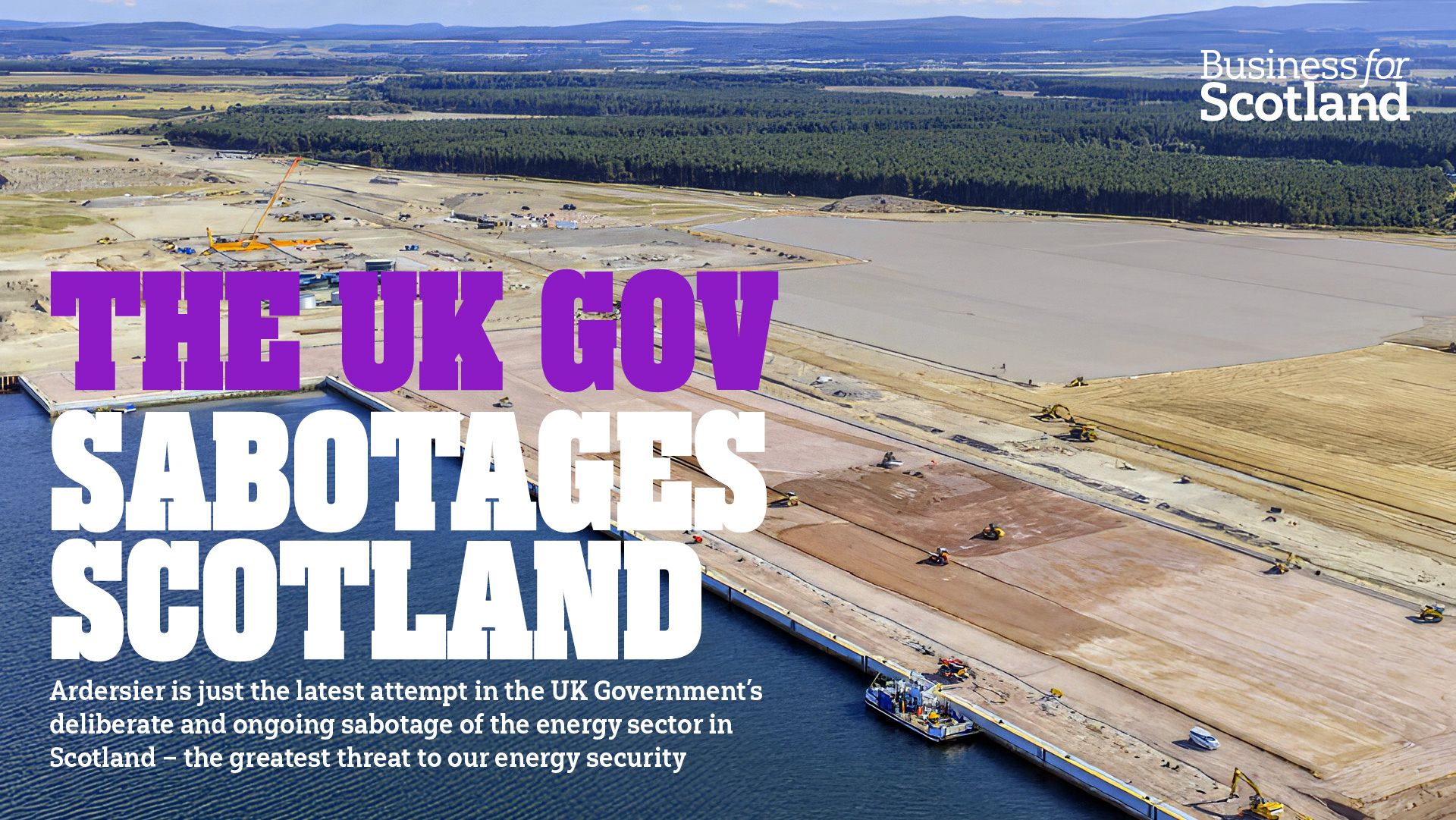
The world’s largest wind turbine plant was due to be built at Ardersier near Inverness in the Highlands. It was a huge deal that took the Scottish government years of hard work to win. It was the Highlands' biggest regeneration project.
The Chinese firm Ming Yang, which was proposing to build the world’s largest wind turbine at Ardersier near Inverness in the Highlands, has now confirmed they are looking at options in Europe.
The UK Labour government blocked the plan - undercutting long years of hard work by the Scottish government to win the £1.5 billion, which would have been Highlands' biggest regeneration project.
Now the BBC has reported: “Following the UK government's decision in March, Ming Yang said it would continue to engage constructively with the UK government, including "on the important topic of national security". It said it remained committed to supporting the UK's mission to become a "clean energy superpower".
“But Ming Yang has now confirmed it is looking at other options. A spokesperson told BBC Scotland News: "We remain in constructive dialogue with all stakeholders in the UK, and we are also evaluating possible sites in a number of countries in continental Europe."
Adersier is the clincher after a list of UK industrial policy failures and betrayals of Scotland
Scots listening to Keir Starmer’s ‘reset’ speech after the SNP’s victory in the Holyrood elections heard only a deafening silence. Starmer bragged about rescuing British Steel in Scunthorpe.
“What about Ardersier, Grangemouth, Mossmoran, Aberdeen and the North-East's oil and gas sector?” many Scots will have shouted at the TV. But there was no mention of Scotland at all.
Westminster played its security card to kill the deal - and the conversation
Westminster said they killed the Ming Yang deal because of “national security”. That is a card they can play whenever they like without explanation - because it is a power reserved to Westminster.
Like kids in the playground taking their ball away, the UK government stopped the Highlands’ biggest regeneration project without even having to say why.
The UK government sat on the deal in surly silence for 18 months, refusing to discuss mitigation of their concerns with the Ming Yang team. Then, just as Holyrood rose for election recess, citing vague "national security" grounds regarding Chinese technology in the energy grid, the UK Government abruptly declared it "cannot support" the use of Ming Yang turbines.
Now Reuters has reported that Ming Yang’s CEO, Horatio Evans, is in active talks with the Spanish government about building the factory there.
The "Security" Smokescreen and UK hypocrisy
The execution of the decision exposed a total lack of both respect for Scottish devolution and transparency. First Minister John Swinney noted that the UK government was effectively “sabotaging Scotland's industrial future.”
Westminster completely failed to address its own glaring hypocrisy. Swinney slammed the veto as an “anti-Scottish move,” pointing out that Westminster continues to embrace Chinese state-backed investment in English infrastructure, with projects such as:
-
- China General Nuclear Power Group (CGN)—a state-owned enterprise directly controlled by the Chinese government owns a 23% equity stake in Hinkley Point C nuclear power station
- Westminster pushed the approval of a massive Chinese "super-embassy" in the heart of London through, explicitly overriding local council rejections and ignoring warnings from MI5 and GCHQ that the site poses unmitigable espionage and national security risks
- The China Investment Corporation (CIC), which is China’s official, state-owned sovereign wealth fund, owns a 10% equity stake in Heathrow Airport Holdings.
- The China Investment Corporation (CIC) holds a major stake in Cadent Gas, the UK’s largest gas distribution network.
- The Minety battery storage project in Wiltshire is one of the largest grid-scale battery facilities in Europe. It is funded, built, and operated by China Huaneng Group (a massive Chinese state-owned power company) alongside the CNIC, a Chinese government-backed investment fund.
- The China Investment Corporation (CIC) - China’s state-owned sovereign wealth fund - owns an 8.7% equity stake in the parent company of Thames Water.
Yet a wind turbine factory in the Highlands poses an unmanageable threat to national security?
No evidence for Westminster’s “security” call
Ming Yang Europe's CEO, Horatio Evers, has also completely dismantled the security scare, noting that the firm designed its setup to be fully aligned with robust cyber regulations. Evers clarified that “there is no risk to energy systems” and that neither Ming Yang nor any third party could remotely shut down wind farms or disrupt the grid.
Yet Westminster rejected the safeguards anyway, letting the decision sit on their desks for 18 months before dropping the axe precisely as the Scottish Parliament rose for election recess.
The background
Ardersier sits at the mouth of the Cromarty Firth, within the Inverness and Cromarty Firth Green Freeport. This industrial site was a hub of the oil platform industry in the 70s and 80s, where thousands of skilled workers built massive structures.
Its reincarnation as an Energy Transition Zone was backed by a hard-fought £50 million from the Scottish Government’s Scottish Investment Bank, alongside matching funds from the UK Infrastructure Bank.
Landing the Ming Yang deal to make the transition was not an overnight fluke; it was the culmination of a years-long diplomatic effort to secure what would have been the world's largest wind turbine manufacturing facility.
The Scotsman reported on internal documents that reveal just how extensively Scottish ministers wooed the renewables giant to secure these 1,500 highly skilled manufacturing jobs for the Highlands:
- Years of Groundwork: Scottish Development International (SDI) had been working intensively on the proposition since 2023, hosting multiple inward trade visits.
- Ministerial Courting: First Minister John Swinney personally met Ming Yang's chairman, Zhang Chuanwei, multiple times - including a crucial meeting at London's International Investment Summit and a formal follow-up summit at Bute House.
- Global Trade Missions: Business Minister Richard Lochhead travelled directly to China to tour manufacturing hubs, while Deputy First Minister Kate Forbes consistently pushed the UK Department for Business and Trade to streamline the deal.
The yard was cleared, the groundwork was laid, and a full offshore wind manufacturing ecosystem - building turbine blades, nacelles, and floating wind components domestically - was within grasp.
Scotland is already central to Europe’s offshore wind ambitions. We have the coastline, the seabed, the engineering heritage and the renewable resources. Yet Scotland repeatedly fails to capture the manufacturing and long-term industrial benefits associated with that energy boom. Too often, the infrastructure is built elsewhere while Scotland provides the raw resource. The world’s largest wind turbine to be built at Ardersier looked like a chance to change that.
Then Westminster intervened.
Labour Defends the unacceptable Veto
Instead of standing up for 1,500 Scottish workers, Scottish Labour leader Anas Sarwar went on the defensive for his bosses in London. Sarwar dismissed the Scottish Government’s fury over the lost investment as “crankery” and a “pretty strange conspiracy theory,” claiming that the security services must always be obeyed without question - when there is a case to be made that other Chinese investments around the UK could be far more security sensitive.
Before the last general election, Sarwar pledged that Grangemouth jobs would be saved and that millions would be found for a transition to a green aviation fuel hub. He blames the Prime Minister for his parties woeful performance at Holyrood 2026 but surely he must also take the lion's share of the blame due to his providing case study after case study to prove that Scottish Labour won't stand up for Scotland.
The greatest threat to Scotland's energy security and to the affordability of Scottish energy bills is the UK Government's deliberate and ongoing sabotage of Scotland's energy sector.
From the McCrone Report to Renewables: A Pattern of Suppression
To understand why Westminster blocked Ardersier, closed Grangemouth and Mossmoran and betrayed the North East's oil and gas workers, you have to look past the immediate excuses and look at the history of the British state. This isn't new; it is a continuation of a decades-old structural strategy.
In 1974, the UK government received The McCrone Report. Written by the brilliant economist Gavin McCrone, the document explicitly concluded that the discovery of North Sea oil would make an independent Scotland incredibly wealthy, giving it a currency "as strong as the Swiss franc" and an embarrassingly large financial surplus.
What did Westminster do? They didn't celebrate Scotland's economic fortune. Instead, they classified the report and hid it from the Scottish public for thirty years. They systematically downplayed Scotland's economic viability to manufacture a narrative of dependency, using Scottish oil wealth to fund tax cuts and regeneration projects in London and the south of England while letting Scotland's heavy industries rust.
Westminster’s sabotage of Scotland
The sabotage of Ardersier is the modern equivalent of burying the McCrone Report. There is simply no desire inside the British state to foster a Scotland that appears economically autonomous, industrially self-sufficient, or capable of leading Europe’s green energy boom.
If Scotland successfully captures the entire manufacturing supply chain of the renewables era, the unionist myth that Scotland is "too poor" to survive independently collapses entirely.
Westminster wants to hold onto its power. They do not want Holyrood politicians to venture into the territory of doing deals with international companies, bringing investment and jobs home. That kind of activity takes Scotland ever closer to independence.
A Structural Failure, Not a Coincidence
The green industrial capacity is still going to be built—it just won't be built here. Following the UK block, Ming Yang has wasted no time and is already in active talks with the Spanish government to build the factory there instead.
When Scots hear Westminster politicians talk about saving “British industry”, they hear the historical echo of the McCrone era: English strategic assets matter; Scottish ones are disposable.
Only with independence can Scotland protect its economic assets, secure its green industrial future, control its own vast natural wealth, and ensure that Scottish jobs and economic prosperity are never again sacrificed to serve the political interests of a London parliament.